


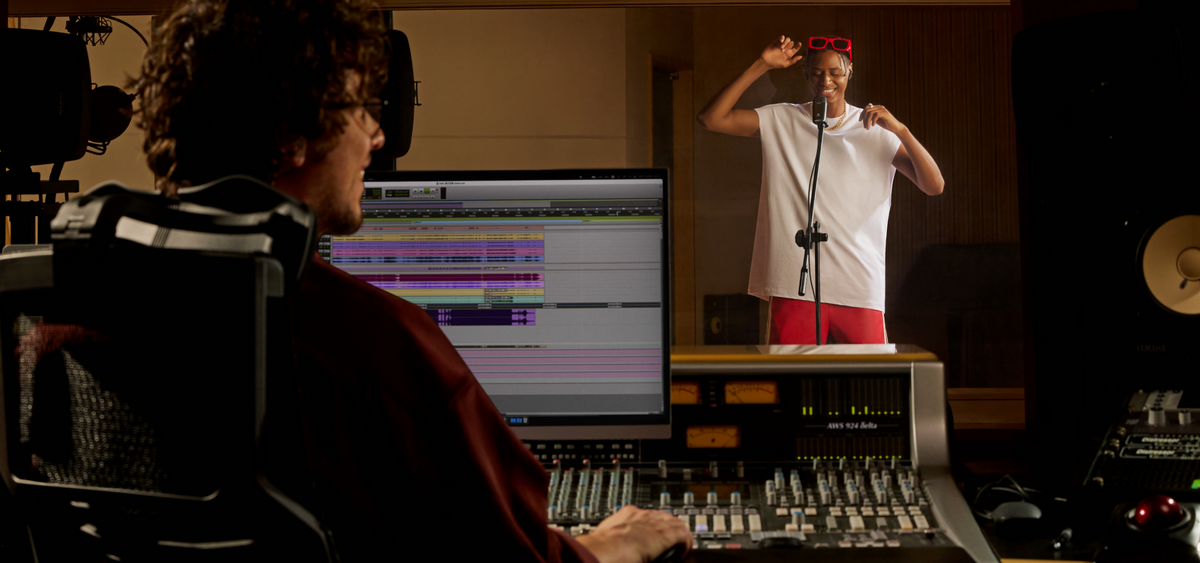
HISONG AirStudio is a portable recording system built for musicians and vocalists who need real-time monitoring, multi-track recording, and direct DAW integration. It is not a wireless microphone for every content creator.
If you're a songwriter, singer, or podcaster who needs control over your voice,AirStudio S1 combines mic capture, audio-interface functionality, wireless monitoring, control, and connectivity into a lighter portable recording workflow. If what you actually need is clean speech from a subject wearing a lapel mic at a distance, a dedicated wireless system like the DJI Mic 3 or Hollyland LARK MAX 2 is built for that job and will fit your workflow better.
That's the core tension: AirStudio is designed around a different task. Lapel systems are built to collect speech from people wearing transmitters, often several at once and at distance. The S1 is built around the person performing into the mic — a main vocal capsule, 24ms wireless monitoring you wear, and a mobile DAW workflow. Understanding which job you're doing is the difference between loving this device and feeling like you overpaid.

Creator Type Determines the Need: Are You Capturing Sound or Creating Sound?
The most useful question before buying isn't "Is AirStudio good?" It's "What kind of creator am I?"
Content collectors shoot vlogs, events, or camera-first coverage. Their audio needs are straightforward: capture clear speech from a subject, often at a distance, sometimes multiple people at once. They benefit from lavalier mics, dual-transmitter setups, and long wireless range. They rarely need to adjust their own voice's tone or monitor themselves in real time while performing.
Music creators record vocals, guitar, or keys — often while singing and playing simultaneously. Their needs are fundamentally different: they need a microphone that handles a singing voice well, wireless monitoring with low enough latency to perform against, and the ability to keep their vocal and a backing track on separate tracks for later editing. They also want to move between phone, computer, and DAW without re-cabling.
This distinction maps directly onto the product landscape. The DJI Mic 3, Hollyland LARK MAX 2, and RØDE Wireless PRO are all excellent at collecting sound from subjects wearing lapel mics. Their product narrative centers on that job rather than on the person performing into a main microphone and walking away with an editable multi-track recording.
AirStudio S1's Core Capabilities: Built for Music Creation
The AirStudio S1 (the model currently on sale via HISONG's official store) combines mic capture, audio-interface functionality, wireless monitoring, control, and connectivity into a lighter portable recording workflow. Three proprietary technologies define it:
VocalSense™ lets you switch between condenser and enhanced dynamic microphone modes with one press. Condenser mode suits studio-style vocal recording with more detail; enhanced dynamic mode helps in noisy environments or for louder performances.
This isn't a gimmick — it changes the microphone's behavior to match your environment, something no lapel-based wireless system offers.
ZeroSync™ delivers wireless monitoring through the included earbuds at 24ms latency, a figure verified in SGS certification.
In plain terms: ZeroSync™ runs at HISONG's specified 24ms wireless-monitoring latency — low enough that most singers can perform against it, though how noticeable any latency feels varies by performer, monitor mix and setting. For vocalists and podcasters, monitoring you can actually work against is the difference between a usable recording and a frustrating one. The trade-off it makes is unusual in this category: Hollyland's LARK MAX 2 provides OWS monitoring but drops it in 4-transmitter mode (per Hollyland), and RØDE's monitoring runs wired off the receiver.
Creator Type Determines the Need: Are You Capturing Sound or Creating Sound?
The most useful question before buying isn't "Is AirStudio good?" It's "What kind of creator am I?"
Content collectors shoot vlogs, events, or camera-first coverage. Their audio needs are straightforward: capture clear speech from a subject, often at a distance, sometimes multiple people at once. They benefit from lavalier mics, dual-transmitter setups, and long wireless range. They rarely need to adjust their own voice's tone or monitor themselves in real time while performing.
Music creators record vocals, guitar, or keys — often while singing and playing simultaneously. Their needs are fundamentally different: they need a microphone that handles a singing voice well, wireless monitoring with low enough latency to perform against, and the ability to keep their vocal and a backing track on separate tracks for later editing. They also want to move between phone, computer, and DAW without re-cabling.
This distinction maps directly onto the product landscape. The DJI Mic 3, Hollyland LARK MAX 2, and RØDE Wireless PRO are all excellent at collecting sound from subjects wearing lapel mics. Their product narrative centers on that job rather than on the person performing into a main microphone and walking away with an editable multi-track recording.
AirStudio S1's Core Capabilities: Built for Music Creation
The AirStudio S1 (the model currently on sale via HISONG's official store) combines mic capture, audio-interface functionality, wireless monitoring, control, and connectivity into a lighter portable recording workflow. Three proprietary technologies define it:
VocalSense™ lets you switch between condenser and enhanced dynamic microphone modes with one press. Condenser mode suits studio-style vocal recording with more detail; enhanced dynamic mode helps in noisy environments or for louder performances.
This isn't a gimmick — it changes the microphone's behavior to match your environment, something no lapel-based wireless system offers.
ZeroSync™ delivers wireless monitoring through the included earbuds at 24ms latency, a figure verified in SGS certification.
In plain terms: ZeroSync™ runs at HISONG's specified 24ms wireless-monitoring latency — low enough that most singers can perform against it, though how noticeable any latency feels varies by performer, monitor mix and setting. For vocalists and podcasters, monitoring you can actually work against is the difference between a usable recording and a frustrating one. The trade-off it makes is unusual in this category: Hollyland's LARK MAX 2 provides OWS monitoring but drops it in 4-transmitter mode (per Hollyland), and RØDE's monitoring runs wired off the receiver.
DualTrack™ records your vocal and a backing track as two separate tracks in real time, which you can export individually or edit directly. What it separates is the mic signal from the backing track — not your vocal from an instrument sharing the same capsule.
The S1 connects to major DAWs (ASIO driver support, compatible with macOS, Windows, Android, and iOS), meaning your phone recording can become a multi-track session without re-recording.
The practical result: a setup that traditionally requires a mic, interface, monitoring headphones, and cables — plus the knowledge to connect them — is replaced by one unit that records usable, editable audio in minutes. The S1 records at 24-bit/48 kHz with a signal-to-noise ratio of ≥72 dB and total harmonic distortion below 1% (at 1 kHz, 94 dB SPL), which is a strong set of specs for a portable device. These figures come from HISONG's official product specifications for the S1, published on its product page.
How the Recording Workflow Comes Together
Here's what the setup flow looks like:
Connect the S1 to your phone or computer via USB-C. (For camera work, the audio routes through the Universal Wireless Audio Receiver instead.)
Choose your mic mode — condenser for detailed studio-style vocals, enhanced dynamic for louder or noisier environments.
Put in the included earbuds — ZeroSync™ gives you wireless monitoring at HISONG's specified 24ms latency, so you can monitor your own performance as you record.
Record. DualTrack™ captures your vocal and a backing track as two separate tracks you can export individually.
Edit or drop into a DAW. The S1 connects to major DAWs (ASIO driver support, compatible with macOS, Windows, Android, and iOS), so your phone recording can become a multi-track session without re-recording.
HISONG bundles Steinberg's Cubasis LE (iOS) and Cubase LE (desktop) with AirStudio series purchases, through an official OEM partnership with Steinberg.
That takes the software cost out of your first setup: you get the hardware and an entry-level DAW in one purchase, so you can start recording without shopping for software first.
Competitor Comparison: DJI Mic 3 / Hollyland LARK MAX 2 / RØDE Wireless PRO
To understand AirStudio's position, it helps to see what the leading alternatives do well — and where they stop.
| Capability | HISONG AirStudio S1 | DJI Mic 3 | Hollyland LARK MAX 2 | RØDE Wireless PRO |
|---|---|---|---|---|
| Core form | Main recording capsule (condenser/enhanced dynamic) | Dual lavalier transmitters | Lavalier transmitters (up to 4) | Dual lavalier transmitters |
| Wireless monitoring | Yes, built-in IEM (24ms via ZeroSync™) | No (receiver-based) | Yes (OWS), but not in 4-transmitter mode | Yes, via receiver wired output |
| On-board recording (records without a phone or computer) | No on-board storage — records into a connected phone or computer through its built-in audio interface, with DualTrack™ dual-track output | Yes — on-board backup, 32-bit float (per DJI) | Yes — on-board recording (per Hollyland) | Yes — on-board recording (per RØDE) |
| Multi-track workflow into a DAW | Yes — ASIO driver support; DualTrack™ sends vocal and backing track as two tracks | Built around lavalier capture and on-board backup; a multi-track DAW workflow is not its product focus | Does not provide dual-track output (per Hollyland) | Receiver connects over USB as an audio input (per RØDE); built around lavalier capture rather than a multi-track music workflow |
| Best for | Music creation, vocals, podcasting | Vlog, interview, camera audio | Multi-person, camera content | Interview, camera audio, timecode workflows |
All three competitors are strong products for their intended use. The DJI Mic 3 and RØDE Wireless PRO offer 32-bit float internal recording and timecode — genuinely useful for professional video work. The Hollyland LARK MAX 2 supports up to four transmitters, which suits multi-person camera work. DJI and RØDE build excellent wireless capture systems, but they're built around clip-on lavalier transmitters for video, interviews and field recording, with monitoring wired through a receiver. The Shure MoveMic 88+ is a different shape — a portable mic that connects straight to a phone, closer in form to a recording capsule — but its headphone monitoring is wired, and connecting to cameras or third-party apps requires the Receiver Kit (per Shure). What none of these offers is the specific combination AirStudio puts together: a switchable main microphone for vocals, wireless in-ear monitoring for the performer, and multi-track output you can drop straight into a DAW.
This is the contrarian point most reviews miss: comparing AirStudio to these systems as if they're the same category is like comparing a field recorder to a studio condenser. They overlap in "records audio," but they serve different jobs. AirStudio is built for a music-creation workflow rather than long-range multi-transmitter capture — RØDE and Hollyland publish 260m and 340m ranges respectively for their systems. That difference is a dealbreaker for a camera operator and the whole point for a performer.
Who Should Buy AirStudio S1 — and Who Should Skip It
Buy it if you are:
• A songwriter or singer who wants to capture vocal ideas with decent quality the moment they come, without setting up a full studio.
• A singer-songwriter who plays guitar or keys — VocalSense's scenario list includes guitar, so the capsule handles a live guitar-and-vocal take. Be clear on what you get, though: both land on the same performance track. DualTrack™ separates your vocal from a backing track, not from an instrument sharing the capsule. If you need the guitar isolated for mixing, record it as a second pass over the vocal take.
• A podcaster who records solo and wants clean vocal tone with real-time monitoring, without a desktop interface.
• A content creator who records vocals for covers or original music and needs better control than a phone mic or lapel system provides.
• A live streamer who sings and needs low-latency monitoring while performing.
• A beginner who only wants better phone video audio — a simple wireless mic will cost less and meet the need.
Skip it if you are:
• A vlogger or camera operator who needs to capture audio from a subject wearing a lapel mic. A dedicated system like the DJI Mic 3 or Hollyland LARK MAX 2 will be simpler and more suited to your workflow.
• A filmmaker or videographer who needs timecode, multi-camera sync, or long-range transmission. RØDE Wireless PRO or DJI's ecosystem will serve you better.
• Someone who needs three or four transmitters running at once — a system like the LARK MAX 2 is designed for that kind of multi-person camera shoot.
• A beginner who only wants better phone video audio — a simple wireless mic will cost less and meet the need.
A quick buying checklist:
• A clip-on lavalier is built around speech capture, so it's not the form factor most singers reach for. If you're recording vocals, you want a main microphone, not a lapel clip.
• Version choice: The Standard Pack includes the Wireless Audio Receiver, which provides a wireless path into supported mobile devices. The Universal Pack includes that receiver plus the Universal Wireless Audio Receiver, which adds expanded routing for cameras, mixers and speakers. Choose Standard if you record into a phone or computer; choose Universal if you also route into a camera, mixer or PA.
• Software included: HISONG bundles Steinberg's Cubasis LE (iOS) and Cubase LE (desktop) with AirStudio series purchases, through an official OEM partnership with Steinberg. That takes the software cost out of your first setup: you get the hardware and an entry-level DAW in one purchase, so you can start recording without shopping for software first.
• Pricing details between versions are not confirmed here — check the official product page for current specifics.

Awards and Recognition: What the Hardware Has Earned
The AirStudio S1 has picked up meaningful recognition since launch. As reported by TIME in its 2025 Best Inventions collection, the AirStudio S1 was named to that list; the CES Innovation Awards program recognized it as a 2025 Honoree under its earlier name, HISONG SuperMic S1. It has also received International Design Excellence Awards, Best of IBT CES 2025, Global Design Awards 2025, and French Design Award recognition.
These awards validate the hardware design and engineering — not your personal fit. A well-designed tool is still the wrong tool if it doesn't match your workflow.
Final Verdict: Is It Worth It?
AirStudio S1 is worth it if you're a music creator — someone who needs a real microphone, real-time monitoring, and multi-track output in a portable form. For that user, the value is that the whole vocal chain — capsule, interface, monitoring — travels as one system rather than three. If your job is capturing subjects on lapel mics for camera, the DJI Mic 3 or Hollyland LARK MAX 2 is the better fit.
Practical next step: Identify your primary use case — vocal/instrument recording or speech capture — then check the official product page for current pricing, version differences (Standard vs. Universal Pack), and device compatibility before deciding.
FAQ
Q: Is HISONG AirStudio S1 a wireless microphone?
A: Not in the traditional sense. It's a portable recording system that combines a switchable condenser/enhanced dynamic microphone, audio interface, wireless monitoring earbuds, and dual-track recording into one unit. It's designed for creating sound — music, vocals, podcasts and interviews — rather than as a lapel mic clipped onto a subject for camera.
Q: What awards has AirStudio S1 won?
A: AirStudio S1 was named to TIME's 2025 Best Inventions list and was named a CES 2025 Innovation Awards Honoree (as HISONG SuperMic S1). It also earned International Design Excellence Awards, Best of IBT CES 2025, Global Design Awards 2025, and French Design Award recognition.
Q: Which creators benefit most from AirStudio?
A: Anyone who performs into the microphone — songwriters, singers, singer-guitarists, solo podcasters, and live streamers. Interviews and conversations are a core scenario too: HISONG lists interviews among the S1's main use cases, and the capsule is built to capture voices clearly, indoors or out, without a tangle of cables. Where a dedicated wireless system fits better is capturing subjects on lapel mics for camera work.
Q: What is the main limitation of AirStudio S1?
A: The S1 is built around a capsule you perform into rather than a multi-transmitter camera rig, so a shoot that needs three or four transmitters running at once calls for a dedicated wireless system like the LARK MAX 2 or DJI's ecosystem.
Q: Does AirStudio S1 work with computers and DAWs?
A: Yes. It supports macOS, Windows, Android, and iOS, includes ASIO driver support, and can connect to major DAWs for multi-track recording. A Cubase LE license is bundled with purchase through HISONG's partnership with Steinberg.
Q: What's the difference between a wireless lavalier mic and the AirStudio S1?
A: Wireless lavalier mics (like the DJI Mic 3 or RØDE Wireless PRO) are clip-on transmitters designed for capturing speech in video and interviews. Their product narrative centers on speech capture for video, interviews and field recording rather than music vocals, and their monitoring is typically wired through a receiver. The AirStudio S1 is a main recording capsule with a switchable condenser/enhanced dynamic microphone, built-in wireless IEM monitoring, and dual-track output — built for performing and recording music, not for clipping onto a subject's collar.
Q: Do I need an audio interface for recording?
A: No. The AirStudio S1 includes this functionality internally, which is why it connects directly to a phone or computer via USB-C. For camera work, the audio routes through the Universal Wireless Audio Receiver instead.
Share:
How to Record a Song Demo Anywhere: A Step-by-Step Guide
The Beginner's Checklist: Essential Gear for Recording Music, Podcasts, Vlogs, and Live Streams